
Growing for the third consecutive month, the country's exports rose marginally by 0.67 per cent year-on-year to $27.93 billion in February even as trade deficit widened to $12.62 billion, according to official data released on Monday.

Since January 2021, the inflation rate in health has stood in the range of 6.08-8.44 per cent.

No longer Bengal's finance minister, Amit Mitra, Mamata's principal chief advisor, will still advise and aid the 'chief minister and finance department on all matters relating to management of state finance', represent the 'state government in national and international events/meetings/committees' and examine 'important proposals/files and policy issues relating to financial matters referred to him for advice/views'.

Sebi has now said any default of payments of interest or principal on loans taken from financial institutions, including banks, will have to be disclosed if it continues beyond 30 days.
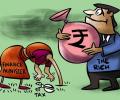
While the tax-to-GDP ratio of 9.88 per cent has been assumed for FY21, the same as last year, when it touched a decadal low, for FY22 a ratio of 10.7 per cent has been assumed, an average of the last five years.

However, Icra Rating Principal Economist Aditi Nayar feels that the numbers are a bit too optimistic and need real heavy-lifting by the Centre and the states. "The survey forecasts on real and nominal GDP will require a substantial push from Central and state spending as private sector capacity expansion is anticipated to be intermittent, and sector-specific in the next couple of quarters," she said. Nayar added that private consumption is likely to chart a differentiated recovery across income and age groups. Based on the comments made in the Survey, she expects the Union Budget to incorporate a growth in gross tax revenue of 15-16 per cent.
Experts warn of over-interpreting the numbers and said their sustainability needed to be watched beyond November, says Indivjal Dhasmana.

Options include fresh capital infusion by the management and/or some new investors.

'Pump prices of petrol and diesel have reached historical highs. An unwinding of taxes on petroleum products by both the Centre and the states could ease the cost-push pressures,' the Monetary Policy Committee (MPC) has said.

The retail inflation rate breached the 6 per cent upper tolerance limit of the RBI for the first time in seven months in January, while the wholesale price index stayed in double-digits for the 10th month in a row, showed two sets of data released by the government on Monday. Retail inflation, the key input for the RBI while reviewing the repo rate every two months, soared during the month mainly because of a spike in certain food items. The previous high for retail inflation was 6.26 per cent in June 2021.

Scanty rainfall, last year's lockdown, growing competition from Nepal and the disaster of the 2017 Gorkhaland agitation are steadily weakening exports and sales of Darjeeling tea.

At over 6 per cent, most states in October had inflation rates above the Reserve Bank of India's target band of 2-6 per cent.

Industrial production re-entered the negative territory by contracting 1.6 per cent in January, mainly on account of the decline in output of capital goods, manufacturing and mining sectors. The output of the manufacturing sector -- which constitutes 77.6 per cent of the Index of Industrial Production (IIP) -- shrank by 2 per cent in January, as against a growth of 1.8 per cent during the same month last fiscal, as per data released by the government on Friday. The worst performance was witnessed by the capital goods sector, which recorded a contraction of 9.6 per cent during the month under review, compared to a 4.4 per cent decline a year ago.

If raters get away by moving from AAA to D overnight after companies default, as happened with DHFL, YES Bank, RCom, and IL&FS, it shows a complete breakdown in the rating system. It calls for exemplary punishment, not kid glove treatment, says Debashis Basu.

India's industrial production grew by 1 per cent in December, official data showed on Friday. According to the Index of Industrial Production (IIP) data, the manufacturing sector output grew by 1.6 per cent in December 2020.


The ministry of health and family welfare spent Rs 3,948 crore in May this year compared to Rs 7,816 crore in the corresponding month of the previous year. On the other hand, at Rs 12,930 crore, the expenditure had risen almost 200 per cent in April against Rs 4,327 crore in the corresponding month of 2019-20.
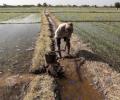
Among the states due for election next year are AP, Haryana and Odisha, which have a fair share of agri credit. If these states individually announced debt relief, the combined waiver would be at least around Rs 600 bn to Rs 700 bn. Clearly, this will be a frightening challenge for Indian banks.
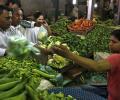
Declining vegetable prices brought down the retail inflation to a 15-month low of 4.59 per cent in December and within the comfort zone of the Reserve Bank, government data showed on Tuesday. It is for the first time during the current fiscal that the Consumer Price Index (CPI) based inflation print is below 6 per cent or in the RBI's target range of 2 to 6 per cent. The central bank factors in the CPI-based inflation while arriving at its monetary policy. The inflation in December 2020 came down from 6.93 per cent in November, mainly on account of 10.41 per cent decline in vegetable prices over the year-ago period.
The fiscal deficit rose primarily on the back of lower non-tax revenues, which came in at 60 per cent of full-year target, compared with 62.4 per cent for the same period last year.

Imports too declined 26 per cent to $29.47 billion in August, leaving a trade deficit of $6.77 billion.

If the industrial sector expanded, growth rate is likely to rise in the remaining quarters to reach 7.6-7.8 per cent for 2017-18.

Outlay for infra is also expected to see a significant increase in view of the government's Rs 111-trillion investment plan under the national infrastructure pipeline to develop social and economic infrastructure over five years.

Sectors with positive growth during the month include rice, iron ore, oil seeds, oil meals, meat, dairy and poultry products, pharmaceuticals, coffee, engineering goods, and plastic.

New norms are in place to strengthen regulations for this set of lenders which has been playing a critical role in Asia's third largest economy, notes Tamal Bandyopadhyay.

If imputed inflation for April and May is used, then you have inflation of over 6 per cent for two consecutive quarters, which is a worrying signal for the RBI.

To meet the revised estimates for 2019-20, the central government will have to garner Rs 5.03 trillion in total revenues in March, which has seen the worst phase of the coronavirus pandemic so far and the resultant lockdown.
India Ratings principal economist Sunil Kumar Sinha said the Brexit is a mixed bag for the country.
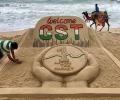
Mop up grows 10% y-o-y at Rs 1.05 trillion, almost equal to levels in February before a nationwide lockdown to contain the coronavirus pandemic

'While collections under the Income Disclosure Scheme explain it partly, indirect tax numbers not showing any effect of the withdrawal of high denomination currency notes was puzzling.'

If the government cuts wasteful expenditure as it is trying now, the deficit would at most fall to 8 per cent, not less than that.

To make possible discretionary spending including capex and that on welfare, the government decided to borrow more than planned in FY21 -- Rs 12.7 trillion.

An expected withdrawal of FIIs from the market likely to weaken the rupee against the dollar.

A government official said out that with hardly any economic activity, an immediate duty hike will not be productive and could be announced once the lockdown eases and demand revives.

Import segments which recorded negative growth include gold, silver, transport equipment, coal, fertiliser, machinery and machine tools. However, exports of oil seeds, coffee, rice, tobacco, spices, pharma, and chemicals reported positive growth in June.
These core industries comprise 40.27 per cent of the weight of items included in the Index of Industrial Production.

'The real lifting of the economy will happen only if this momentum sustains in the coming months.'

Is the worst over for Indian banks? The past two years saw them ride on treasury trades as deposits soared and credit growth dipped sharply. Gross and net non-performing assets (NPAs) moved south, and the provision coverage ratio (PCR), capital buffers, and profitability indicators are back at pre-pandemic levels. So, what's the plot ahead?
While the ratio determines the extent to which the government is able to finance its expenditure, it is also an indicator of tax compliance. Developed countries have a higher contribution of tax to their GDP.
Inflation in food articles, fuel and power contracted in July.
 © 2026 Rediff.com - Advertise with us - Disclaimer - Privacy Policy - Sitemap - Feedback - About us - Terms of use - Grievances